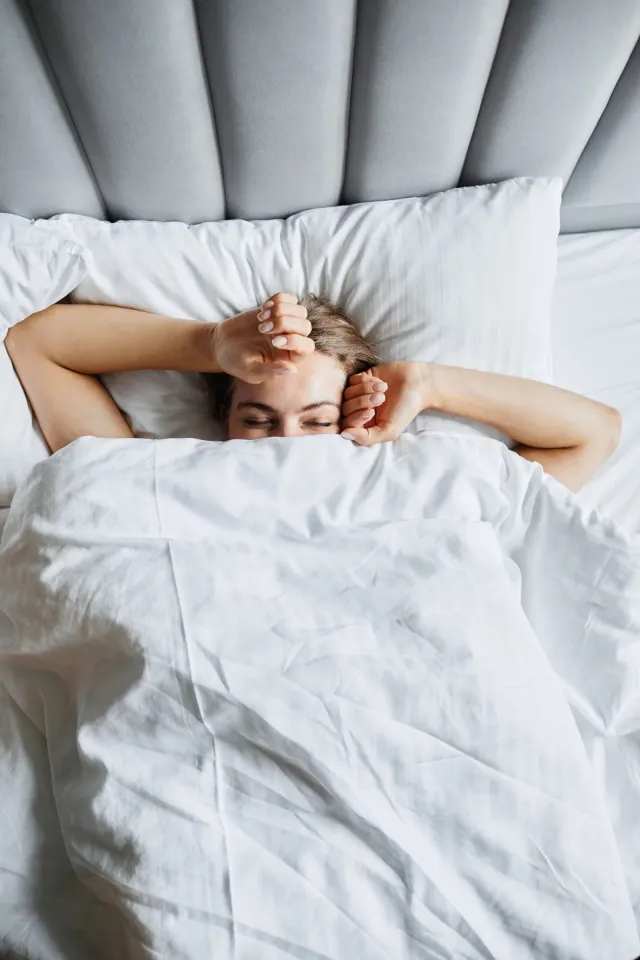


A 21-day plan · Sleep
Wake up rested
A steadier sleep schedule for three weeks, so mornings stop feeling like a fight. If it takes you ages to fall asleep, start with Fall asleep faster.
 Up at your wake-up time
 Lights out on time
 No late caffeine or alcohol
 Magnesium add-on
Run it in the By Day app on iPhone or Android.
For you if
- You wake up tired even after a full night.
- Your bedtime drifts, and weekends shift everything.
- You need coffee just to get going.
You’ll need
- A phone alarm to wake up.
- A second alarm to start winding down.
- Optional supplement: Magnesium add-on, from day 8. You can skip it.
How you’ll know
- Your morning 1-5 ratings are higher than in week one.
- You wake up close to your alarm, sometimes before it.
- You need less coffee to get going.
What runs when
Days 1–21
 Set-upChoose your wake-up time · Choose your lights-out time set-up, day 1
- Up at your wake-up time required, days 2 to 21
- Lights out on time required, days 2 to 21
- No late caffeine or alcohol required, days 3 to 21
- Magnesium add-onoptional · never required optional, days 8 to 21
Usually 3 required habits a day, never more than three. Day 1 is set-up: choose your wake-up time and choose your lights-out time. Optional rows never count toward your results or a lifetime place.
Checkpoints
- Day1
Set-up: choose your wake-up time, then choose your lights-out time. Set a reminder for each.
- Day3
Early mornings feel hard now. By evening you'll likely be sleepier, which makes lights-out easier.
- Day7
Weekends are the test. Staying within an hour of your wake-up time keeps Monday from feeling like jet lag.
- Day8
Week-one check-in: a short look back, then keep going or stop. Stopping never counts against you.
- Day14
Compare your 1-5 ratings with week one. If mornings are still rough, look at the evenings: is lights-out slipping?
- Day21
Decide what to keep. The wake-up time and lights-out time do most of the work.
Why it works
Your body runs on a clock that likes regular times. Getting up at the same time every day, with some morning daylight, sets that clock, and a fixed lights-out time protects enough hours for sleep. Caffeine late in the day and alcohol close to bed both cut into your sleep, even when you don't notice.
Sleep experts recommend at least 7 hours a night for adults. Regular sleep times and morning light help keep the body clock steady; irregular schedules are linked to a later body clock. Caffeine and alcohol both measurably disrupt sleep, even at ordinary amounts. The evidence for magnesium is limited.Sources
Results
If you connect Apple Health, Health Connect or Oura, the plan adds total sleep, measured against your first nights and marked still forming until day 14. What you notice yourself is the main measure.

Before you start
- This is a wellness program, not a treatment. If you feel tired all the time even with enough sleep, talk to a doctor: it can have medical causes.
- Loud snoring, pauses in breathing at night, or dozing off during the day can be signs of a sleep disorder. Please see a doctor.
- Not designed for night shifts or rotating shifts.
- Don't drive or use machinery if you feel very sleepy.
- Before trying the magnesium add-on, check with a clinician if you're pregnant or breastfeeding, have kidney problems, or take other medicines.
Access
- Now
- Free, with every feature, during the open beta. No card, no end date yet.
- A lifetime place
- Finish your first full 21-day plan during the beta with at least 80% of its required habits done and, if fewer than 200 people have qualified before you, Explorer is yours for life straight away. Stopping early doesn’t count against you; the first plan you run to its end is the one that counts.
- After the beta
- One active plan, daily habits, mood, recaps and history stay free. Explorer, the paid tier, adds every plan and connected health readings.
- Where
- The By Day app on iPhone and Android, to run it and to look back.
Sources and the strength of each
Watson et al., AASM and Sleep Research Society consensus (2015). Adults should sleep 7 or more hours a night on a regular basis.
Evidence: expert consensusBrown et al., PLOS Biology (2022). Expert recommendations: bright light in the daytime, dim light in the evening, to support sleep and alertness.
Evidence: expert consensusPhillips et al., Scientific Reports (2017). Students with irregular sleep had a later body clock, with melatonin released hours later; an observational study.
Evidence: observational studyGardiner et al., Sleep Medicine Reviews (2023). Caffeine cut total sleep; a regular coffee should be at least about 8.8 hours before bed.
Evidence: meta-analysisGardiner et al., Sleep Medicine Reviews (2025). Even about two drinks delayed and reduced REM sleep, and more alcohol made it worse.
Evidence: meta-analysisMah & Pitre, BMC Complementary Medicine and Therapies (2021). Magnesium may help some older adults fall asleep faster; low-certainty evidence.
Evidence: low certainty
By Day is not a medical device and does not diagnose or treat any condition.
The other four plans




Occasional updates
Hear when a new plan ships.
A short note when a new plan or a meaningful change is ready. One confirmation email first, and no spam.